
Strong Body Strong Mind Card Games is a topic that helps readers understand popular card games in the online gambling environment. Baccarat, blackjack, and poker have different rules, payout structures, and levels of skill involvement. Understanding game rules, house edge, pot odds, and expected value allows participants to evaluate decisions based on probability rather than intuition. However, no strategy can guarantee winning outcomes in every situation. Technical knowledge should be combined with bankroll management, stake control, and appropriate financial limits to maintain a balanced approach to online card gaming.
Exploring Strong Body Strong Mind Card Games
Online card games include various formats with distinct outcome-determination mechanisms. When exploring Strong Body Strong Mind Card Games, readers should distinguish between predominantly probability-driven games such as baccarat, blackjack with its strategic decisions, and poker, where players compete against one another. These differences directly influence how each game should be analyzed and how its risks should be evaluated.
Baccarat and Basic Betting Options
Baccarat typically features three main betting options: Player, Banker, and Tie. Results are determined by the total value of the cards, while the third-card rule establishes when additional cards must be drawn.
The Banker bet generally has a slight mathematical advantage over the Player bet in standard baccarat, although winning Banker wagers may be subject to commission. Tie bets offer higher payouts but usually carry a significantly greater house edge.
When researching Strong Body Strong Mind Card Games, participants should review payout rates, commissions, and table limits. Consecutive Banker or Player results do not prove that the opposite outcome is more likely to occur in the next round.
Blackjack and Basic Strategy

Blackjack requires players to achieve a hand total closer to 21 than the dealer without exceeding that limit. Common decisions include hit, stand, double, and split, depending on the cards held.
A soft hand contains an Ace that can be counted flexibly, while a hard hand does not offer the same adjustment. Dealer rules and blackjack payouts also influence the house edge.
In Strong Body Strong Mind Card Games, basic strategy supports probability-based decisions. However, decision charts must match specific table rules because a strategy effective in one variation may not apply unchanged to another.
Poker and the Role of Player Skill
Poker differs from many casino card games because participants generally compete against one another rather than directly against the house. Outcomes depend on hand rankings, starting hands, position, and the ability to analyze different situations.
Pot odds help players evaluate the relationship between the cost of calling a bet and the potential reward. Bluffing, semi-bluffing, and estimating opponents’ hand ranges can also influence strategic decisions.
For Strong Body Strong Mind Card Games, poker requires effective chip stack management and the ability to adapt to table dynamics. Despite the importance of skill, variance means that reasonable decisions can still produce losing outcomes in the short term.
Analyzing Probability in Strong Body Strong Mind Card Games

Probability provides the foundation for understanding differences between casino card games. In Strong Body Strong Mind Card Games, concepts such as house edge, probability, and expected value provide a mathematical basis for evaluating individual betting decisions. These principles do not predict the exact outcome of a single hand but instead describe expected results over repeated situations.
House Edge and Probability in Card Games
House edge represents the mathematical advantage held by the operator over the long term, determined by game rules and payout structures.
In baccarat, Banker and Player bets have different house edges. Blackjack is influenced by dealer rules and player decisions. In player-versus-player poker, operators generally collect rake rather than applying a traditional house edge through the same mechanism.
When evaluating Strong Body Strong Mind Card Games, readers should distinguish between long-term mathematical advantages and short-term results. A winning session does not change the underlying probabilities, just as a losing streak does not indicate that a major payout is approaching.
Pot Odds, Expected Value, and Decision-Making
Pot odds are a poker concept used to compare the amount required to call a bet with the potential reward available in the pot. When combined with equity, they help players evaluate whether continuing a hand is mathematically reasonable.
Expected value describes the theoretical average profit or loss of a decision based on probabilities and potential payouts. This concept supports risk-reward analysis rather than emotionally driven choices.
In Strong Body Strong Mind Card Games, these analytical tools can reduce errors when evaluating different situations. Nevertheless, a decision with positive expected value can still result in a loss because of variance in individual hands.
Martingale and the Risks of Increasing Stakes
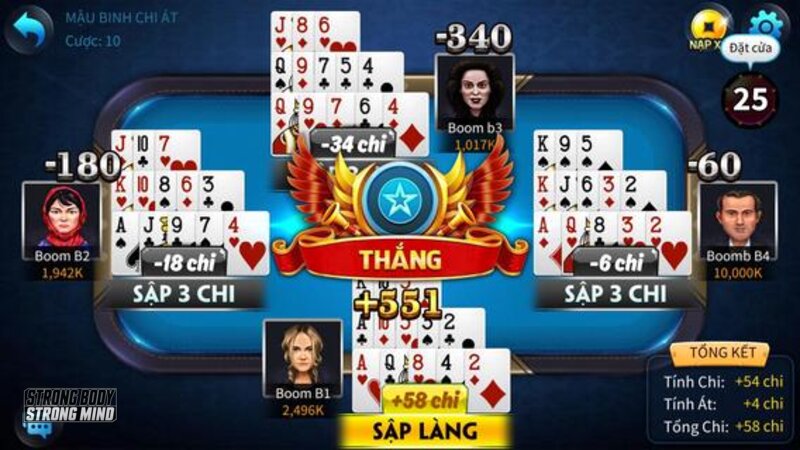
Martingale is a betting system that increases stakes after each loss, based on the expectation that a subsequent win will recover previous losses. Fibonacci and other progressive betting systems also adjust wager sizes according to predetermined sequences.
The main problem is that the required bankroll can increase rapidly during extended losing streaks. Participants may reach table limits or exhaust their available funds.
In Strong Body Strong Mind Card Games, increasing wager amounts does not change the house edge or the winning probability of an independent round. Chasing losses through larger stakes can cause financial damage to accumulate much faster than originally planned.
Managing Risks in Strong Body Strong Mind Card Games
Online card games can operate continuously, particularly at live dealer tables. Therefore, in Strong Body Strong Mind Card Games, bankroll management, stake control, and emotional discipline should be considered just as important as understanding game rules. A clear financial plan helps reduce impulsive decisions during periods of winning and losing.
Building a Bankroll and Managing Stakes
A bankroll is a dedicated entertainment budget that should remain separate from living expenses, bills, and essential financial obligations.
Participants can divide their funds into several sessions and use betting units to determine appropriate stake sizes. Wagering an entire budget on a single hand or repeatedly increasing bets after losses can create significant financial risks.
In Strong Body Strong Mind Card Games, tracking profits, losses, and total wagering amounts allows players to assess their spending more objectively. Once a predetermined stop-loss limit is reached, ending the session can prevent additional spending beyond the original budget.
Controlling Emotions After Wins and Losses
Winning streaks can create overconfidence, causing participants to overestimate their predictive abilities. Conversely, consecutive losses may lead to tilt, revenge betting, or attempts to recover lost money immediately.
These emotional states can reduce decision-making quality and encourage participants to increase stakes beyond their planned budgets.
When participating in Strong Body Strong Mind Card Games, players should recognize warning signs such as wagering while angry, repeatedly changing strategies, or extending sessions solely to recover losses. Taking regular breaks and respecting predetermined limits can help reduce emotionally driven behavior.
Practicing Responsible Online Card Gaming
Online card gambling is an entertainment activity involving financial risk, not a reliable source of income. Participants should meet legal age requirements and comply with regulations applicable in their jurisdiction.
Players should not borrow money to gamble, use funds intended for essential expenses, or continue participating when gambling negatively affects their work or personal lives.
If a platform provides deposit limits, time limits, or self-exclusion tools, users may consider these features to support better control over their gambling behavior.
A responsible approach to Strong Body Strong Mind Card Games should prioritize financial stability, realistic expectations, and the ability to stop voluntarily, brought to you by strong body strong mind.
Conclusion: A Balanced Strong Body Strong Mind Card Games Approach
Strong Body Strong Mind Card Games can be understood more comprehensively through knowledge of baccarat, blackjack, poker, and probability-based principles. House edge, pot odds, and expected value help readers evaluate decisions using mathematical reasoning, but they do not guarantee winning outcomes. Each game has different rules and levels of skill involvement. Therefore, bankroll management, stake control, and emotional discipline remain essential principles for maintaining a balanced approach to online card gaming.